Domain Model
A relational foundation you already understand
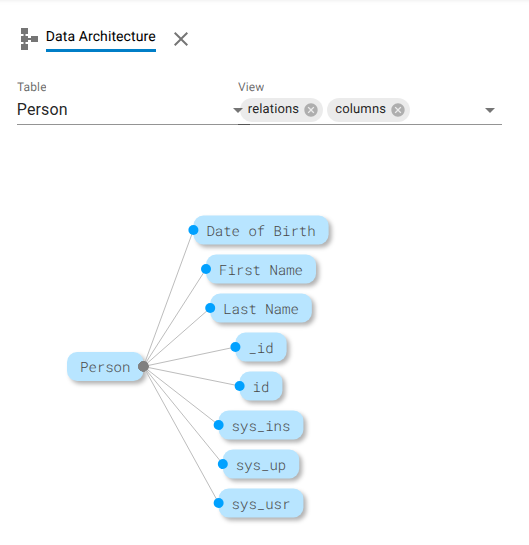
Minyu’s domain model follows the same fundamentals as a traditional relational database. Information is organized into tables, described by columns, and connected through relations. If you are familiar with relational modeling, you already understand the mental model Minyu is built on.
What changes is not the structure itself, but how seriously the system treats it. In Minyu, the domain model is not just where data is stored—it is the authoritative definition of how the system behaves.
Behavior defined directly in the model
On top of tables, columns, and relations, Minyu adds application-level metadata that defines how the model is exposed and used throughout the system. This metadata does not alter the underlying data; it controls behavior.
This includes how data is addressed through APIs, how rows are labeled and ordered in the UI, how relations may be created or reused, and what is visible in forms and lists. All configuration is declarative and attached directly to the model.
From this single definition, Minyu derives user interfaces, navigation, validation behavior, APIs, search, charts, and integrations—without duplicating logic or maintaining parallel representations.
Tables represent real-world entities, columns define both data and interaction, and relations describe how information connects and is allowed to be reused. System-managed metadata ensures that every row remains stable, traceable, and addressable across the platform.
Structure as a long-term asset
Because behavior is derived directly from structure, changes propagate automatically. Adding or refining tables, columns, or relations updates the system consistently across interfaces and integrations without reimplementation or manual synchronization.
Over time, the domain model becomes a living representation of how the organization operates. It remains understandable, durable, and aligned with real work instead of drifting into technical artifacts or scattered rules.
In Minyu, structure is not hidden behind screens or code. It is the backbone that keeps information, logic, and interaction coherent as the system grows.
→ Read more: Data model