Threshold effects (hidden limits)
Summary
Threshold effects happen when a system behaves normally — until it suddenly does not.
Everything looks stable:
- Reports generate.
- Users log in.
- Orders process.
- Automations run.
Then one day:
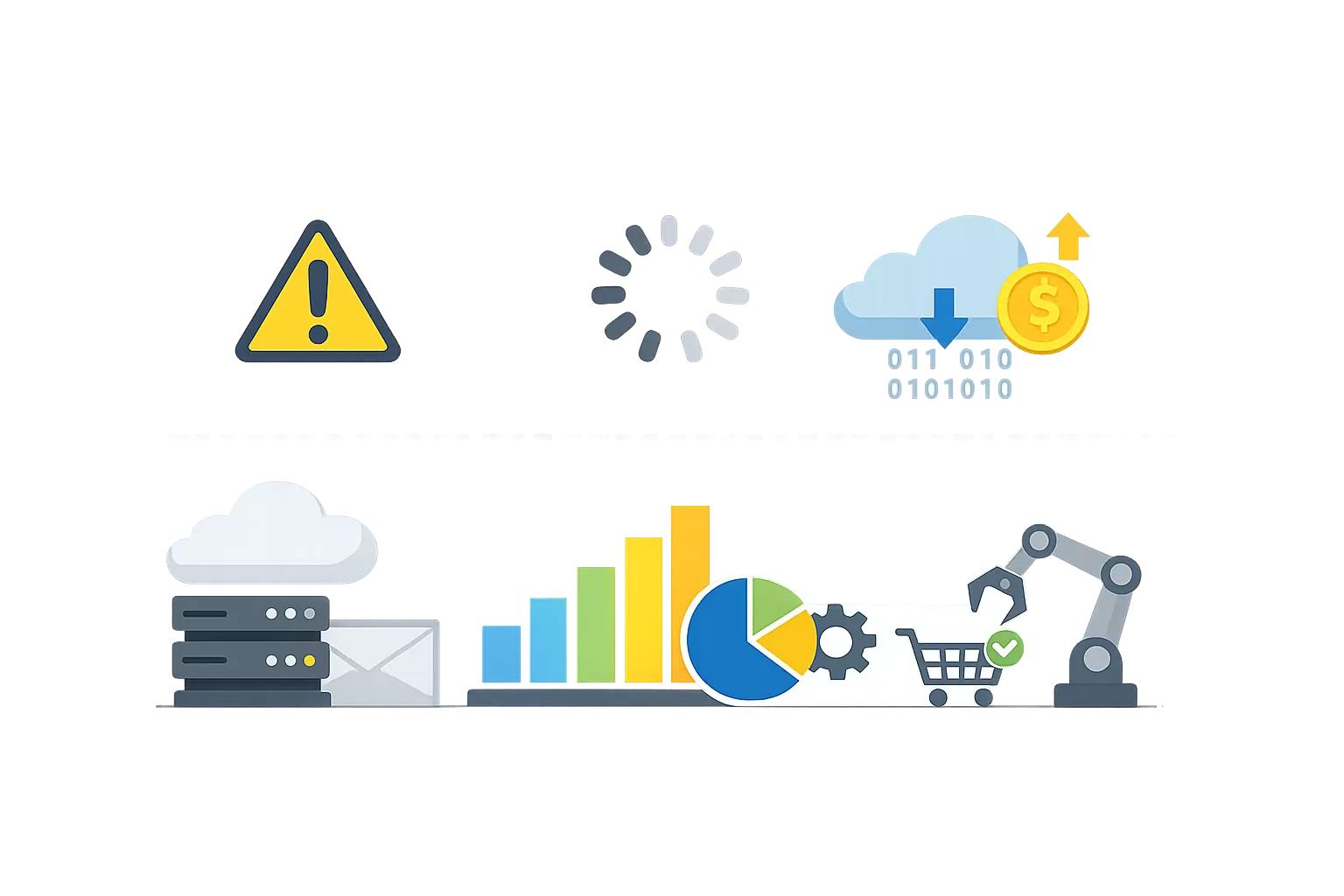
- The system becomes slow.
- Costs increase sharply.
- Errors start appearing.
- Integrations fail.
- Dashboards stop updating.
Nothing obvious changed.
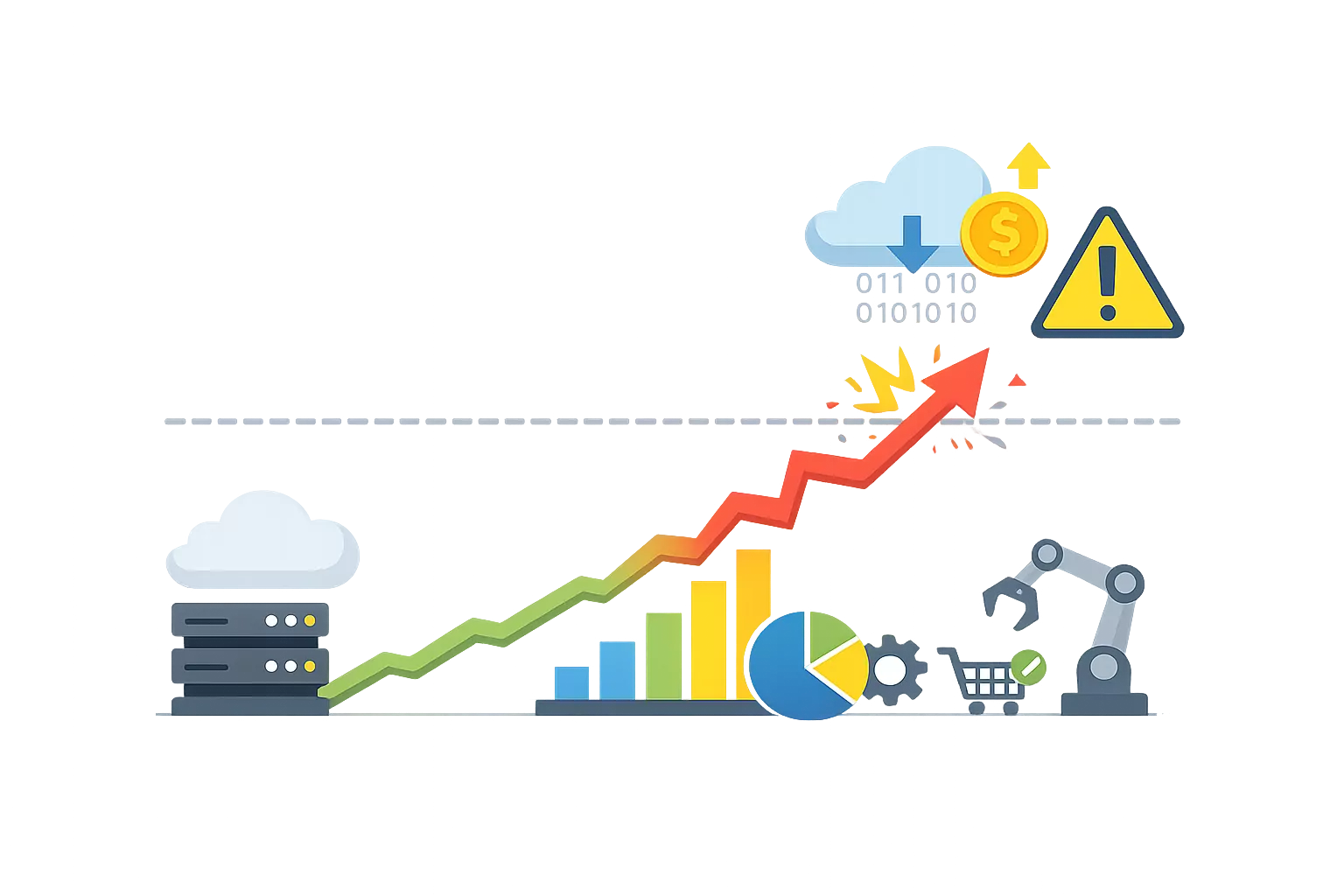
But a hidden limit was crossed.
This is a threshold effect.
Touches lenses:
Processing, Integration, Information
A simple example
Imagine a growing company using a cloud database.
For two years:
- Response times are fast.
- Costs are predictable.
- No performance complaints exist.
The company grows from:
- 1,000 customers
to - 12,000 customers.
Everything still works.
Then at 15,000 customers:
- Queries slow down.
- Reports take minutes instead of seconds.
- Background jobs begin to fail.
Nothing is broken in the code.
But the data volume crossed a structural threshold.
The database was optimized for small datasets. It was never redesigned for scale.
The limit was always there. It was just invisible.
Recognition
You may have a threshold effect if:
- The system works fine for months, then suddenly degrades.
- Performance issues appear after growth.
- Costs rise sharply at specific usage levels.
- Errors cluster around peak hours.
- “It worked yesterday” becomes a common phrase.
The key sign:
The system does not degrade gradually. It changes behavior abruptly.
Below the limit, everything is stable. Above the limit, instability appears.
What is really breaking
The issue is rarely a bug.
It is usually one of these:
- Capacity limits
- Resource limits
- Algorithmic complexity
- License tier limits
- API rate limits
- Data size thresholds
- Timeout boundaries
Many systems include non-linear behavior.
For example:
-
A query that runs in 50 ms at 10,000 rows
may run in 5 seconds at 500,000 rows. -
An API that allows 1,000 requests per minute
may start rejecting calls at 1,001.
The structure contains a boundary.
But that boundary is not visible in daily use.
It only becomes visible when crossed.
Why this happens
Threshold effects occur because systems are built with assumptions.
Examples:
- “We will not exceed 5,000 users.”
- “Orders per day will stay under 10,000.”
- “This dataset will remain small.”
- “Reports will run once per day.”
These assumptions are rarely documented. They live inside:
- Query design
- Infrastructure sizing
- Batch job timing
- Cache configuration
- Subscription plans
When growth or usage patterns change, the assumptions are no longer valid.
The system has not changed.
The context has.
That is enough to cross a threshold.
A second example: API rate limits
An SMB integrates its CRM with a marketing platform.
Each time a customer updates:
- The CRM sends an API call.
- The marketing platform updates the profile.
At 50 updates per hour, everything works.
As the business grows:
- Automated imports run.
- Bulk updates increase.
- More workflows trigger.
Suddenly:
- The marketing platform returns “429 Too Many Requests.”
- Data sync falls behind.
- Teams start manually correcting records.
The integration did not break.
It hit a rate threshold.
The limit was always documented — but not modeled into the system design.
Why it is hard to detect
Threshold effects are difficult because:
- Testing environments rarely simulate real scale.
- Growth is gradual.
- Monitoring focuses on errors, not approaching limits.
- Capacity planning is postponed “until needed.”
The system feels stable — until it is not.
Because the boundary is not visible in dashboards, leaders assume stability.
But stability below a threshold does not guarantee stability above it.
This creates a false sense of safety.
Consequences for SMBs
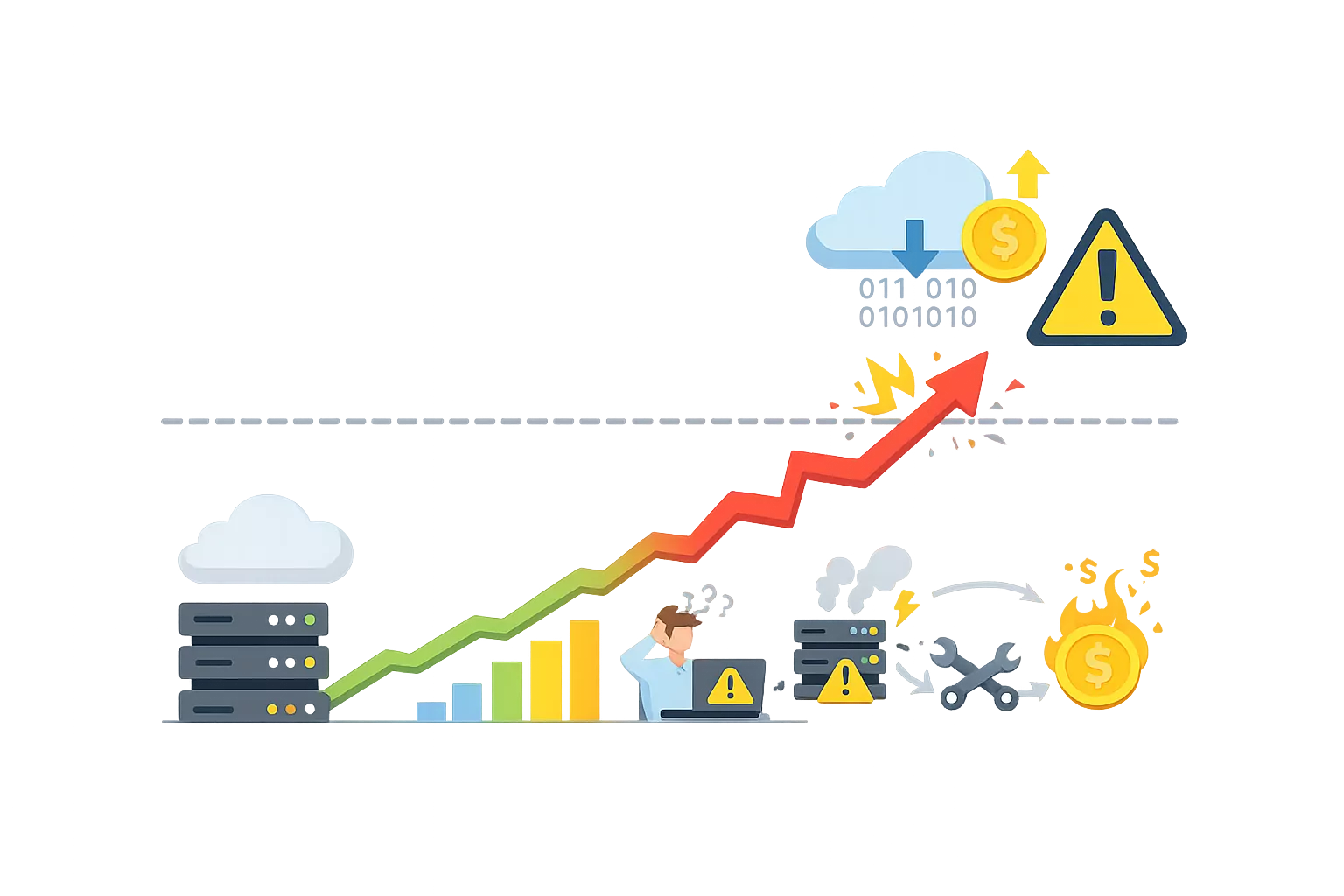
When a hidden limit is crossed:
- Customers experience delays.
- Internal teams lose time troubleshooting.
- Trust in the system decreases.
- Emergency infrastructure upgrades are required.
- Costs rise unexpectedly.
- Automation must be disabled.
Instead of planned scaling, the company enters reactive mode.
Growth becomes risky.
Innovation slows.
Leadership begins asking:
“Why did the system suddenly stop working?”
But the system did not suddenly stop.
It reached its designed boundary.
Types of hidden thresholds
Thresholds can exist in multiple dimensions.
Volume thresholds
- Number of records
- Number of users
- Transaction counts
Time thresholds
- Batch windows
- Timeout limits
- Processing intervals
Resource thresholds
- CPU usage
- Memory limits
- Connection pools
Commercial thresholds
- License tiers
- Pricing bands
- API quotas
Each type can create sudden behavior change.
The danger increases when several thresholds interact.
For example:
More users
→ more data
→ slower queries
→ longer background jobs
→ overlapping job schedules
→ cascading failures.
The threshold is not always a single line. It can be a chain reaction.
Diagnostic tests
To detect threshold risk, ask:
- At what scale was this system originally designed?
- What assumptions were made about growth?
- What happens at double current usage?
- Are rate limits, memory limits, or timeouts documented?
- Do we monitor resource utilization trends?
Another practical test:
Simulate 2–3× current volume in a controlled environment.
If performance drops sharply instead of gradually, a threshold likely exists.
Also ask:
“Is performance roughly linear as usage increases?”
If the answer is no, non-linear behavior may hide a boundary.
Why growth triggers the problem
SMBs often focus on acquiring customers, increasing orders, or automating processes.
Growth is positive.
But structural limits do not disappear because growth is positive.
A system that works well at small scale may:
- Become expensive at medium scale.
- Become unstable at larger scale.
Without explicit capacity modeling, growth exposes hidden limits.
This is why scaling is not only a technical problem.
It is a structural design issue.
Structural resolution
Fixing threshold effects requires making limits explicit.
This can include:
- Documenting expected scale ranges.
- Modeling capacity assumptions.
- Introducing buffering and queuing.
- Adding back-pressure handling.
- Monitoring near-limit indicators.
- Designing for horizontal scaling where possible.
- Stress testing integrations before growth.
Most importantly:
Move from reactive scaling
to
planned scaling.
The goal is not infinite capacity.
The goal is predictable behavior across ranges.
When to act
You should address potential threshold effects when:
- Growth is part of strategy.
- Automation volume is increasing.
- Integration count is rising.
- Data retention is expanding.
- Costs scale unexpectedly.
Waiting until failure occurs makes resolution more expensive.
Addressing limits early makes growth safer.
In short
Threshold effects happen when:
- A system appears stable.
- An invisible limit exists.
- Growth crosses that limit.
- Behavior changes abruptly.
Below the threshold, everything feels fine.
Above it, instability begins.
The solution is not panic.
The solution is structural clarity about limits before they are reached.