Rigid structure disguised as flexibility
Summary
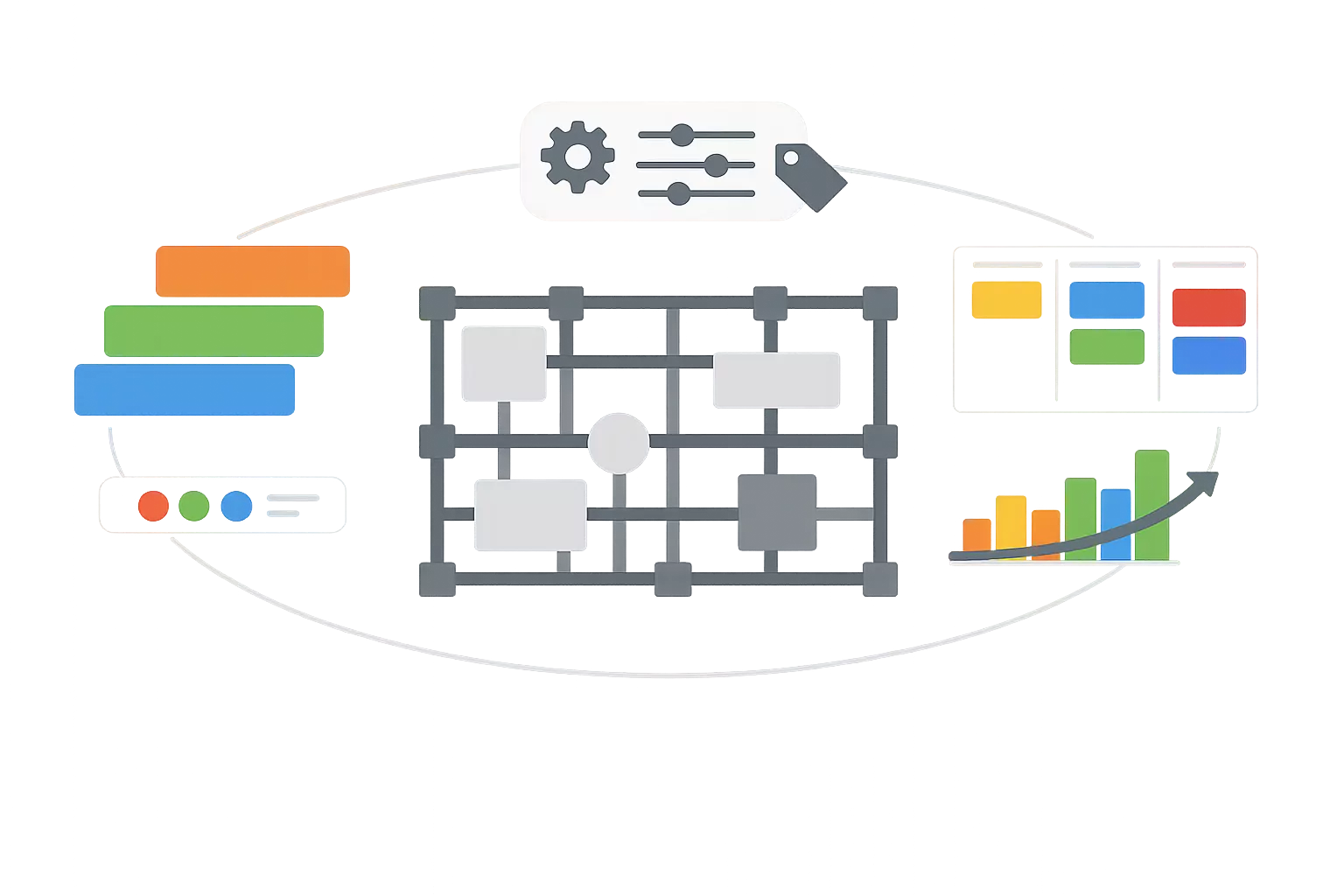
Rigid structure disguised as flexibility happens when a system appears configurable, customizable, or adaptable — but the underlying model is fixed.
Users can rename fields.
They can add optional columns.
They can create extra categories.
But they cannot change the real structure.
The system feels flexible in daily use.
But when the business evolves, it becomes clear that the flexibility was only cosmetic.
Touches lenses:
Information, Processing, Integration
A simple example
A growing company uses a CRM system that allows:
- Custom fields
- Custom statuses
- Custom labels
At first, this feels powerful.
When the company adds a new sales stage, they simply create a new status.
When they need a new data point, they add a custom field.
Everything seems adaptable.
But later, they realize:
- They cannot change how opportunities relate to projects.
- They cannot model multiple parallel sales processes.
- They cannot separate pre-sales from contracted work structurally.
They can add fields.
They cannot change the underlying relationships.
The system was flexible in presentation, but rigid in structure.
Recognition
You may have rigid structure disguised as flexibility if:
- The system allows many custom fields but few structural changes
- New business models require workarounds
- Teams say “we can’t really model that here”
- Excel is used to complement “missing” structure
- Configuration options exist, but core concepts cannot be altered
The system rarely blocks small adjustments.
It blocks structural change.
What is really breaking
The issue is not configuration.
The issue is abstraction depth.
Most systems are built around a fixed internal model:
- Fixed entity types
- Fixed relationship types
- Fixed lifecycle assumptions
- Fixed processing logic
The system may allow variation inside those boundaries.
But the boundaries themselves are not configurable.
For example:
You can rename “Customer” to “Member.”
But you cannot change what a customer fundamentally is in the model.
You can add a “Stage” column.
But you cannot redefine how stages behave in processing.
This creates an illusion:
The surface adapts.
The core does not.

Why this happens
Vendors often optimize for:
- Simplicity
- Predictability
- Fast onboarding
- Standard use cases
To achieve this, they define:
- A clear internal structure
- A limited set of entities
- A fixed lifecycle
Then they add customization features around it.
From a product perspective, this is logical.
Too much structural freedom increases complexity.
But from a business perspective, it creates tension.
Businesses evolve.
Their information structures evolve.
If the system’s internal model cannot evolve with them, friction appears.
Why it is hard to detect early
In early stages, companies often:
- Fit well within standard workflows
- Use only a subset of features
- Avoid complex edge cases
The system feels perfect.
The rigidity only becomes visible when:
- The business model changes
- New revenue streams appear
- Cross-functional processes grow
- Compliance requirements increase
At that point, the system’s structure becomes visible — because it resists change.
The flexibility was sufficient for variation.
It was insufficient for transformation.
A second example: subscription vs project
A company sells both:
- Monthly subscriptions
- One-time implementation projects
Their system models everything as “Deals.”
Deals have:
- A value
- A close date
- A status
Subscriptions and projects are forced into the same structure.
For subscriptions:
- The value repeats monthly.
- The relationship to delivery is ongoing.
For projects:
- The value is fixed.
- Delivery has milestones.
Because the structure is rigid, the company adds:
- Custom fields
- Tags
- Notes
The data fits.
But reporting becomes fragile.
Processing logic becomes inconsistent.
Integration with accounting becomes complex.
The system was flexible enough to store the data.
It was not flexible enough to represent the business correctly.
What it costs
When rigid structure hides behind flexibility:
- Workarounds multiply
- Reporting becomes manual
- Integrations require transformation layers
- Teams create parallel systems
- Decision-making slows
More importantly:
The organization starts adapting to the tool.
Instead of the tool supporting the organization’s structure, the organization reshapes itself to fit the tool.
Over time, this reduces clarity and increases operational friction.

Why SMBs are especially affected
Small and medium-sized businesses often:
- Grow in unexpected directions
- Add services incrementally
- Combine multiple revenue models
- Change internal processes quickly
They need structural elasticity.
Many mainstream tools provide surface configurability but not structural elasticity.
This gap becomes visible precisely when growth accelerates.
Ironically, the moment the business needs flexibility most is when the system reveals its rigidity.
Diagnostic tests
Try these tests:
Test 1 — Relationship test
Can you change how core entities relate to each other?
Or are relationships predefined and immutable?
If relationships cannot evolve, structure is rigid.
Test 2 — Lifecycle test
Can you redefine how an object moves through its states?
Or can you only rename existing states?
If lifecycle logic is fixed, flexibility is limited.
Test 3 — Model evolution test
If you introduce a new business model tomorrow, can the system represent it cleanly without workarounds?
If the answer is “we would need hacks,” rigidity is present.
Structural explanation
True flexibility exists at three levels:
- Field variation (adding attributes)
- State variation (adding statuses)
- Structural variation (changing entities and relationships)
Most configurable systems allow levels 1 and sometimes 2.
Few allow level 3.
Rigid structure disguised as flexibility is the situation where:
- Level 1 is strong
- Level 2 is moderate
- Level 3 is fixed
Because level 1 is visible to users, the system feels adaptable.
Because level 3 is hidden, its limits are not obvious until pressure increases.
Structural resolution guidance
Resolving this pattern does not require unlimited freedom.
It requires clarity about structural boundaries.
Possible approaches include:
- Choosing systems that expose entity and relationship modeling
- Separating presentation flexibility from structural flexibility
- Defining core business concepts independently of tool constraints
- Avoiding overloading single entities to represent multiple realities
- Designing integrations that respect structural differences
The goal is not to remove structure.
The goal is to ensure the structure can evolve with the business.
Flexibility should exist where change is expected.
Rigidity should exist where stability is required.
The problem arises when rigidity hides behind configurable surfaces.
In short
Rigid structure disguised as flexibility happens when:
- The interface allows change
- The underlying model does not
It works well in stable environments.
It creates friction in evolving ones.
Surface flexibility is not the same as structural elasticity.
Understanding the difference prevents long-term constraints from being mistaken for short-term convenience.